















In most countries, a visit ends when someone says goodbye.
In Georgia, this merely announces the beginning of the departure process.
You look at the time and realise you should have left twenty minutes ago.
“I should go,” you say.
Nobody moves.
Your host looks genuinely surprised, as though you have announced an immediate relocation to another continent.
“Why are you leaving so early?”
It is almost midnight.
You explain that you have work tomorrow. This is acknowledged but not considered a sufficient reason to end the evening.
“Sit for five more minutes.”
You sit.
Someone cuts the cake again.
A fresh conversation begins.
And just like that, your Georgian goodbye is officially underway.
“Five Minutes” Is Not a Measurement
In Georgia, five minutes does not always describe a precise amount of time.
Sometimes it means five minutes.
Sometimes it means fifteen.
Sometimes it means:
I have not forgotten you.
I am still planning to come.
Please do not become angry yet.
Ask a Georgian when they will arrive and you may hear:
“Five minutes.”
They might already be nearby.
They might be looking for their keys.
They might have just stepped into the shower.
The important thing is not their current geographical position.
The important thing is their commitment to the general idea of arriving.
This is why “five minutes” should not be understood as information.
It is reassurance.

„მოვდივარ“ Is Not a Location
The Georgian word „მოვდივარ“ means “I’m coming.”
In theory.
In practice, it can describe several stages of preparation:
Thinking about getting ready.
Actually getting ready.
Looking for something that was definitely on the table a moment ago.
Calling to ask where everyone else is.
Leaving the apartment.
Waiting for the elevator.
Starting the car.
Or, occasionally, genuinely travelling toward you.
If you ask:
“Have you left?”
The answer may still be:
„მოვდივარ.“
This does not necessarily confirm movement.
It confirms intention.
Georgian is a language capable of communicating warmth, poetry, hospitality and ancient history.
It has also given us one perfect word for avoiding unnecessary logistical detail.
Six O’Clock Depends on the Occasion
Georgians understand punctuality perfectly well.
We arrive at airports early.
We know that doctors, employers and government offices are unlikely to reorganise their day because we were looking for parking.
But social time follows a different system.
If a business meeting begins at six, six usually means six.
If a birthday begins at six, arriving at six may mean finding the restaurant staff still arranging the tables.
You stand there wearing your nicest clothes while someone places cutlery around you.
The birthday person may not have arrived yet.
Half of the guests are still at home.
Someone is calling someone else to ask:
“Where are you?”
„მოვდივარ.“
Of course.
At Georgian celebrations, fifteen minutes late can feel perfectly punctual.
Thirty minutes may still require no explanation.
An hour is not necessarily a delay.
Sometimes it is an entrance.
Weddings operate in their own timezone.
The invitation provides a useful indication of the evening on which the event will occur.
The precise beginning develops naturally.
Yet somehow, nobody misses anything important.
The food arrives.
The music begins.
The tables fill.
Someone who said they could stay for only an hour is still dancing four hours later.
Everything happens.
Just not always when the invitation suggested it would.

A Quick Coffee Is a Dangerous Proposal
“Come in for a quick coffee.”
This sounds harmless.
You imagine a cup of coffee, perhaps something small and sweet, followed by a polite goodbye.
But there is no reliable connection between the words “quick coffee” and the event that follows.
First, the coffee arrives.
Then fruit.
Then chocolates.
Then somebody remembers there is cake.
You insist you are not hungry.
This information is ignored.
Soon there is cheese, bread, leftovers from lunch and something homemade that you must try because it was brought from the village.
Another person arrives.
The coffee is made again.
You begin discussing families, work, property, politics, somebody’s wedding and the disappointing behaviour of a cousin you have never met.
At some point, you realise it is dark outside.
You came for coffee.
You have eaten dinner.
Nobody finds this unusual.
In Georgia, a quick coffee is not a short event.
It is a door through which the rest of your day quietly disappears.
“Nearby” Is a Philosophical Concept
Time becomes especially interesting when combined with Georgian directions.
“Is it far?”
“No, it’s right here.”
“Right here” may mean around the corner.
It may also mean a twenty-minute drive, followed by a road that becomes increasingly narrow and a final turn beside a building that no longer exists.
Directions may include:
“Turn where the old pharmacy used to be.”
“Pass Giorgi’s house.”
“Not this Giorgi. The other Giorgi.”
“You will see a tree.”
Georgia has many trees.
You call again.
“Where are you?”
“I’m near the church.”
Georgia also has many churches.
“Which church?”
“The old one.”
This clarification does not help.
Eventually, somebody comes to find you. They are surprised that the original instructions were insufficient.
“It was very easy.”
For them, perhaps.
They knew Giorgi.
Georgian Time Can Also Be Immediate
The strange thing is that Georgian time does not always move slowly.
Sometimes it moves with terrifying speed.
A relative calls to say they are nearby.
“How nearby?”
“Downstairs.”
You are still in your pyjamas.
A friend suggests dinner.
“When?”
“Now.”
Someone announces that guests are coming.
“When?”
“They are on the way.”
How many guests?
Nobody knows.
This is when Georgian households reveal their true abilities.
Extra chairs appear.
Food multiplies.
A table designed for six accommodates fourteen.
Someone is sent to buy bread.
Someone else begins cutting cheese.
A jar is opened.
A neighbour contributes something.
Within twenty minutes, the house looks as though the gathering had been planned for days.
Perhaps this is why we do not always plan earlier.
Somewhere in our collective memory is the confidence that, if necessary, an entire celebration can be built before the guests reach the door.
You Came to Return a Container
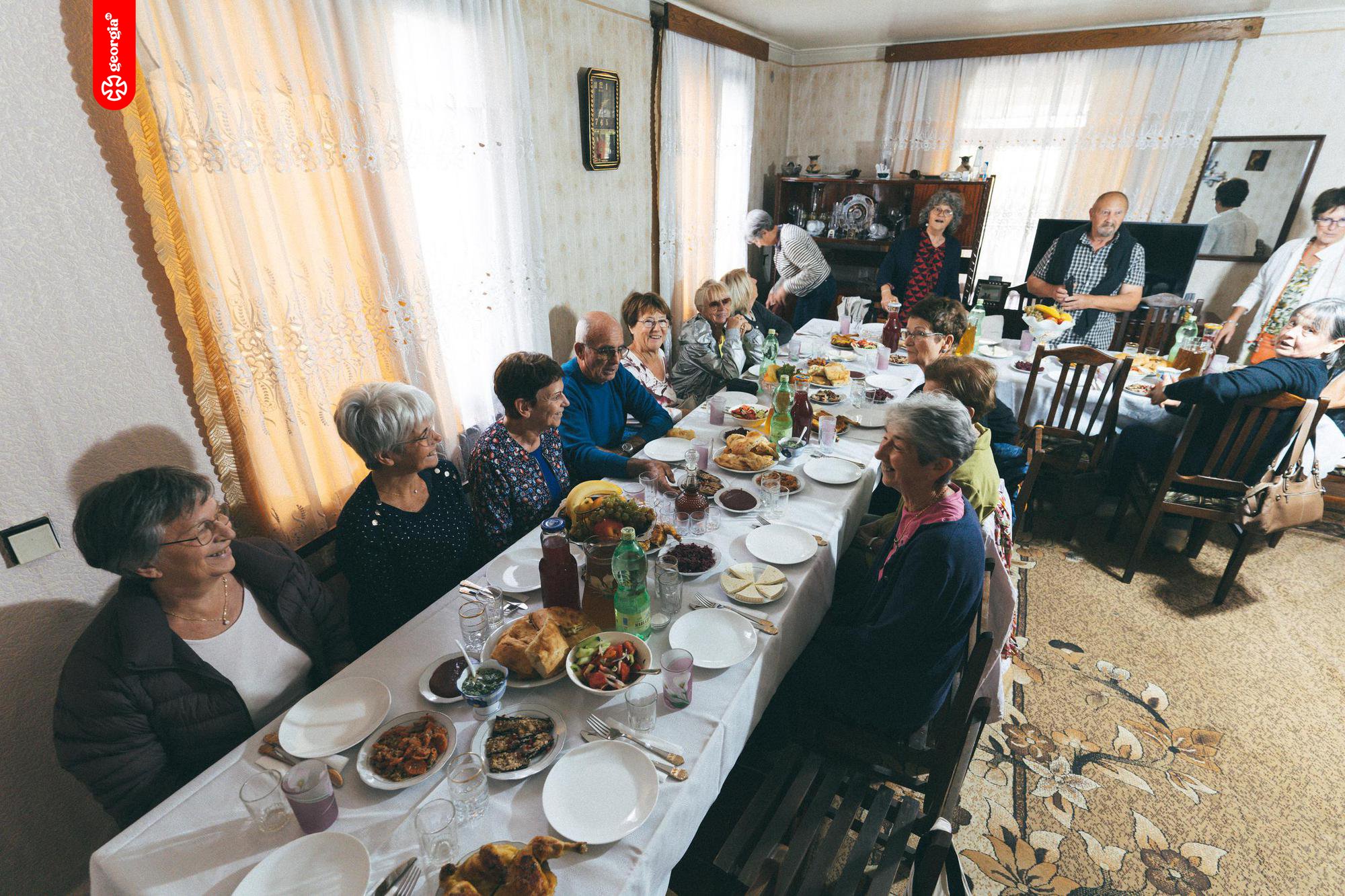
A Georgian household rarely allows a guest to leave empty-handed.
Leftovers are packed.
Cake is wrapped.
Fruit is added.
You protest.
Your protest is rejected.
“You will eat it tomorrow.”
“I already have food at home.”
“Take it anyway.”
This is not a negotiation.
Soon, you are carrying several containers and a bag that appears significantly heavier than anything you brought with you.
Days later, the empty containers remain in your kitchen.
You should return them.
But you cannot return a Georgian container empty. That would feel wrong.
So you put something inside.
Perhaps cake.
Perhaps fruit.
Perhaps food your own family has made.
Then you visit to return it.
You are invited in for a quick coffee.
And the cycle begins again.
Georgian hospitality may appear spontaneous, but it has developed a remarkably effective system for ensuring future contact through reusable kitchenware.
“Call Me When You Get Home”
Georgian time may be flexible, but Georgian concern is precise.
It does not matter that you are an adult.
It does not matter that you have travelled the same road hundreds of times.
It does not matter that the journey takes only fifteen minutes.
You must confirm your safe arrival.
If you forget, your telephone rings.
“Did you get home?”
“Yes.”
“Why didn’t you call?”
“I just arrived.”
“You should have called.”
There is no correct answer.
The call is not really about distance.
It is the final part of the visit.
You arrived as a guest.
You ate.
You talked.
You attempted to leave several times.
You carried food home.
And now, after confirming that you are safely inside, the evening can officially end.
Perhaps We Do Understand Time
It would be easy to say that Georgians are simply late.
Sometimes we are.
But that is not the whole story.
Because we also know exactly when a guest has not eaten enough.
We know when five more minutes together matters more than five minutes on a clock.
We know that a conversation does not become meaningless simply because it has continued past midnight.
We know that returning a container can become a reason to see someone again.
And we know that saying goodbye does not mean immediately turning away.
Perhaps Georgians are not always careless with time.
Perhaps we simply believe it belongs to people before it belongs to clocks.
Time stretches around tables.
It waits beside doorways.
It continues through elevator doors and travels down from balconies.
It stays awake until everyone has called to say they arrived safely.
Still, if a Georgian says goodbye at ten, do not expect them to leave before ten forty-five.
And if they tell you they are coming in five minutes…
Make yourself comfortable.