











Ask a Georgian where their family comes from...
and you may hear part of the answer before they say a word.
Their surname may already be pointing east.
Or west.
Toward the Black Sea coast.
Into the valleys of Samegrelo.
Up into the mountains of Svaneti.
Or toward a village their family left generations ago but has never completely stopped belonging to.
A Georgian surname can preserve the name of
en anfader
ett yrke
en plats
en personlig egenskap eller
hela en släktlinje.
Sometimes it tells us where a family began.
Sometimes it tells us where they passed through.
And sometimes it remembers a home that its descendants can no longer reach.
Because in Georgia, a surname is more than identification.
It is a small piece of geography carried by a person.
ETT GEORGISKT NAMN ÄR OCKSÅ EN KARTA.
Two Endings Almost Everyone Recognises
Even someone who knows very little about Georgia may have noticed two endings:
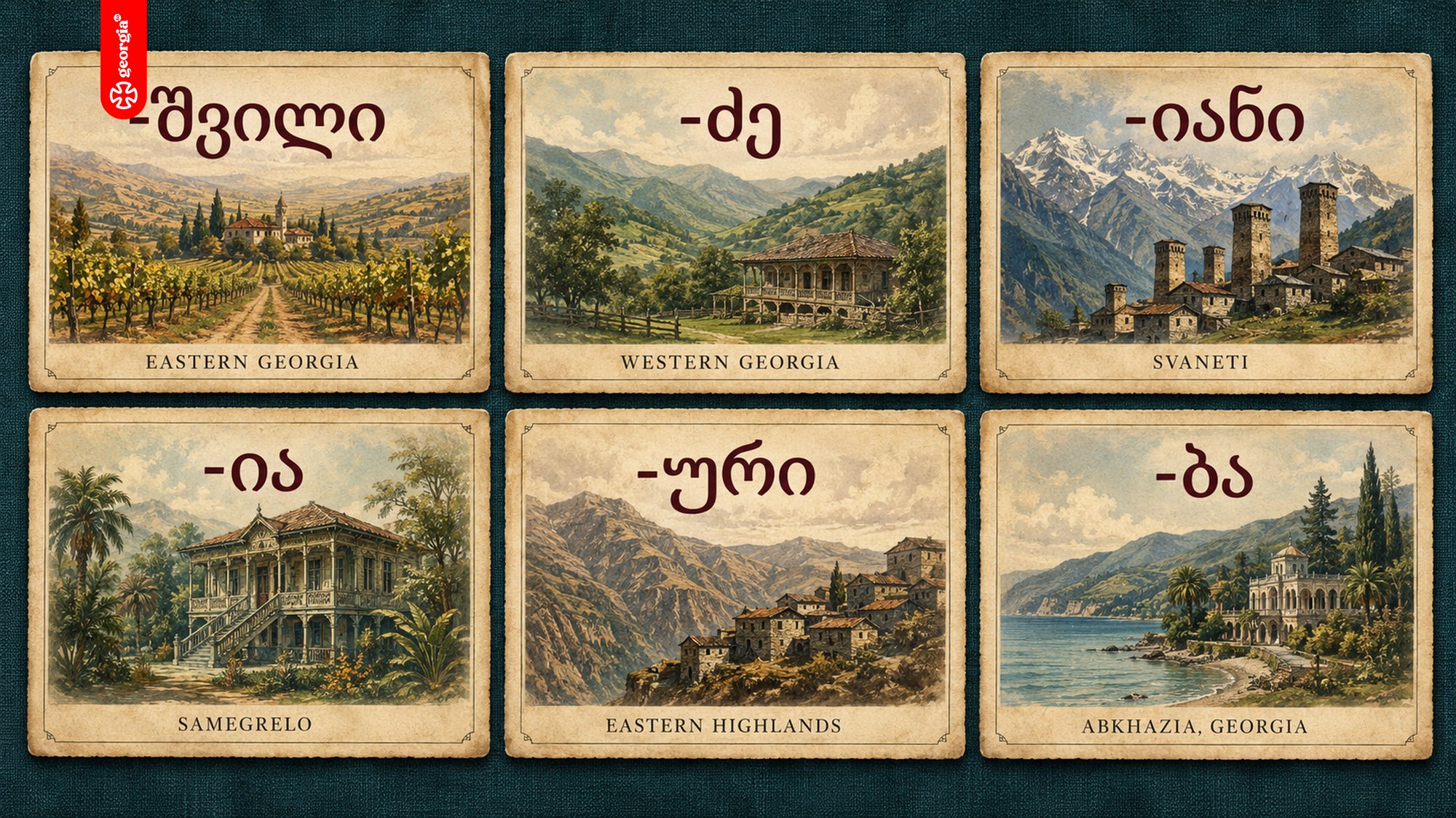
-shvili
and
-dze
They appear in politics, sport, literature, cinema and almost every Georgian contact list.
In Georgian, შვილი — shvili means child or descendant. It is not limited to a son or daughter. It expresses continuation: someone who comes from another person.
The older Georgian word ძე — dze means son.
Both endings therefore speak about descent.
But over time, they also developed distinct geographical associations.
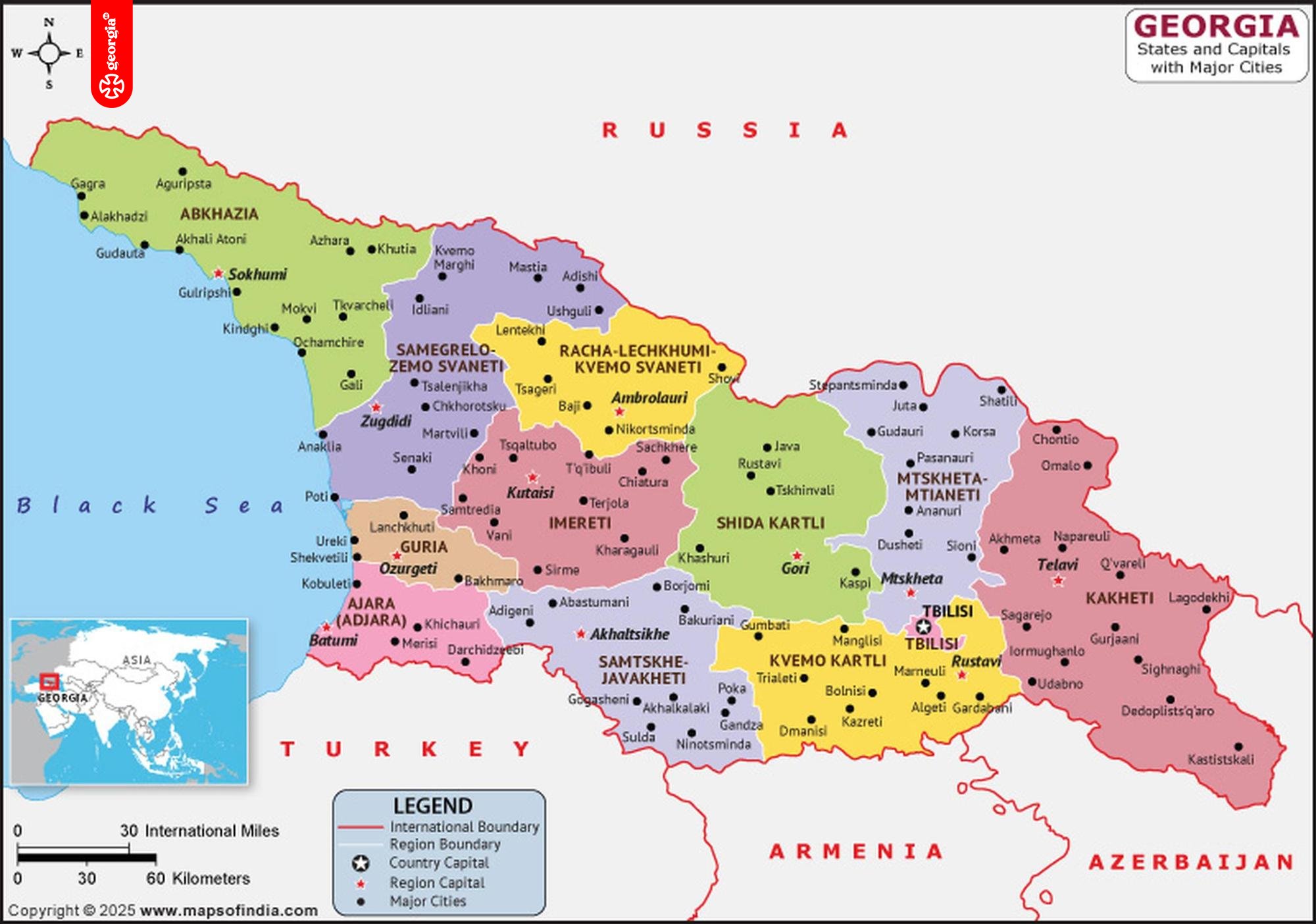
Surnames ending in -shvili are especially common in eastern Georgia, particularly in Kartli and Kakheti.
Surnames ending in -dze are strongly associated with western Georgia, especially Imereti, Guria and Adjara, although they also appear elsewhere.
Gelashvili, Baratashvili or Guramishvili may lead your first guess toward the east.
Beridze, Kapanadze or Abashidze may turn the compass westward.
But only the first guess.
Georgia has spent centuries moving.
Families crossed mountains.
Borders changed.
Kingdoms divided and reunited.
People left villages for cities,
escaped invasions,
followed work,
married into other regions and
built new homes far from the places where their names first appeared.
Så ändelsen kan peka.
Den kan inte vittna under ed.
The Mountains Change the Sound
Travel into Georgia’s eastern highlands and surnames begin to sound different.
In Pshavi, Khevsureti, Mtiuleti, Gudamakari and Khevi, endings such as -uri, -uli and -auri become more familiar.
Tsiklauri.
Gogochuri.
Arabuli.
Burduli.
Gudushauri.
These names belong to a landscape where communities were historically separated not only by distance,
but by rivers,
snow,
narrow passes and
mountains that could close the road for months.
A valley was not merely somewhere a person lived.
It shaped the community around them.
It influenced how people built,
travelled,
defended themselves,
celebrated and
remembered their dead.
The family name became part of that structure.
Move west into Svaneti and parts of Georgia’s northwestern highlands, and endings such as -iani and -ani become more noticeable.
Names like Dadeshkeliani, Ioseliani and Gelovani carry another regional rhythm, one associated with households, lineages and belonging.
Not every name ending in -iani comes from Svaneti.
Not every Svan surname ends in -iani.
But the pattern is strong enough that a Georgian hearing the name may already begin constructing a possible family geography.
Before asking anything...
they have an idea.
It may be correct.
It may be completely wrong.
But the map has opened.
Samegrelo Writes the West Differently
Continue toward Samegrelo and Georgian surnames change again.
Megrelian is part of the Kartvelian language family, closely related to Georgian but carrying its own vocabulary, sounds and grammatical history.
Its surnames often end in forms such as:
-ia
-ua
-ava
and -skiri
Kvaratskhelia.
Chichua.
Gvazava.
Gamsakhurdia.
Papaskiri.
These endings immediately evoke western Georgia for many Georgian listeners particularly Samegrelo and the cultural world shaped by the Enguri and Rioni river valleys, the Colchian lowlands and the Black Sea.
They are Georgian surnames formed through another Kartvelian language.
This distinction matters.
Georgia has never needed every region to sound identical in order to belong to the same country.
The differences are part of the map.
Ett georgiskt efternamn plattar inte till landet till ett enda språkmönster.
Det avslöjar hur många mönster landet har lyckats förena.
Sometimes the Name Gives You the Place Directly
Some surnames do not merely hint at a region.
They appear to point toward a particular place.
The ending -eli can express a relationship with a location: someone belonging to, associated with or coming from somewhere.
The most famous example is probably Rustaveli.
Shota Rustaveli’s name connects him to Rustavi, although historians have long debated which historical Rustavi that connection referred to.
Den exakta punkten på kartan kan förbli osäker.
Logiken i namnet gör det inte.
A person was remembered through a place.
The same geographical principle survives in other Georgian surnames and historical names. A fortress, village, district or ancestral estate could eventually become part of a family’s identity.
Long before passports contained a permanent address...
the name carried one.
The First Part of the Name Has a Story Too
The ending may tell us how the name was formed.
But the beginning tells us what the family chose, or was once chosen to remember.
Many Georgian surnames developed from the given name of an ancestor.
Others emerged from occupations, titles, villages, physical characteristics, personal habits or nicknames.
Perhaps an ancestor was known for the work he performed.
Perhaps he came from another region and was identified by it.
Perhaps one characteristic distinguished him so clearly that the description eventually became a family name.
Den ursprunglige personen försvann.
Beskrivningen blev kvar.
After several generations, nobody needed to remember why the name had begun.
It was simply theirs.
This is one of the quiet miracles of surnames.
An ancestor whose face has been forgotten can remain present inside a word.
The house may disappear.
The profession may no longer exist.
The village may have changed its name.
But every time someone introduces themselves, a small part of the original story is spoken again.
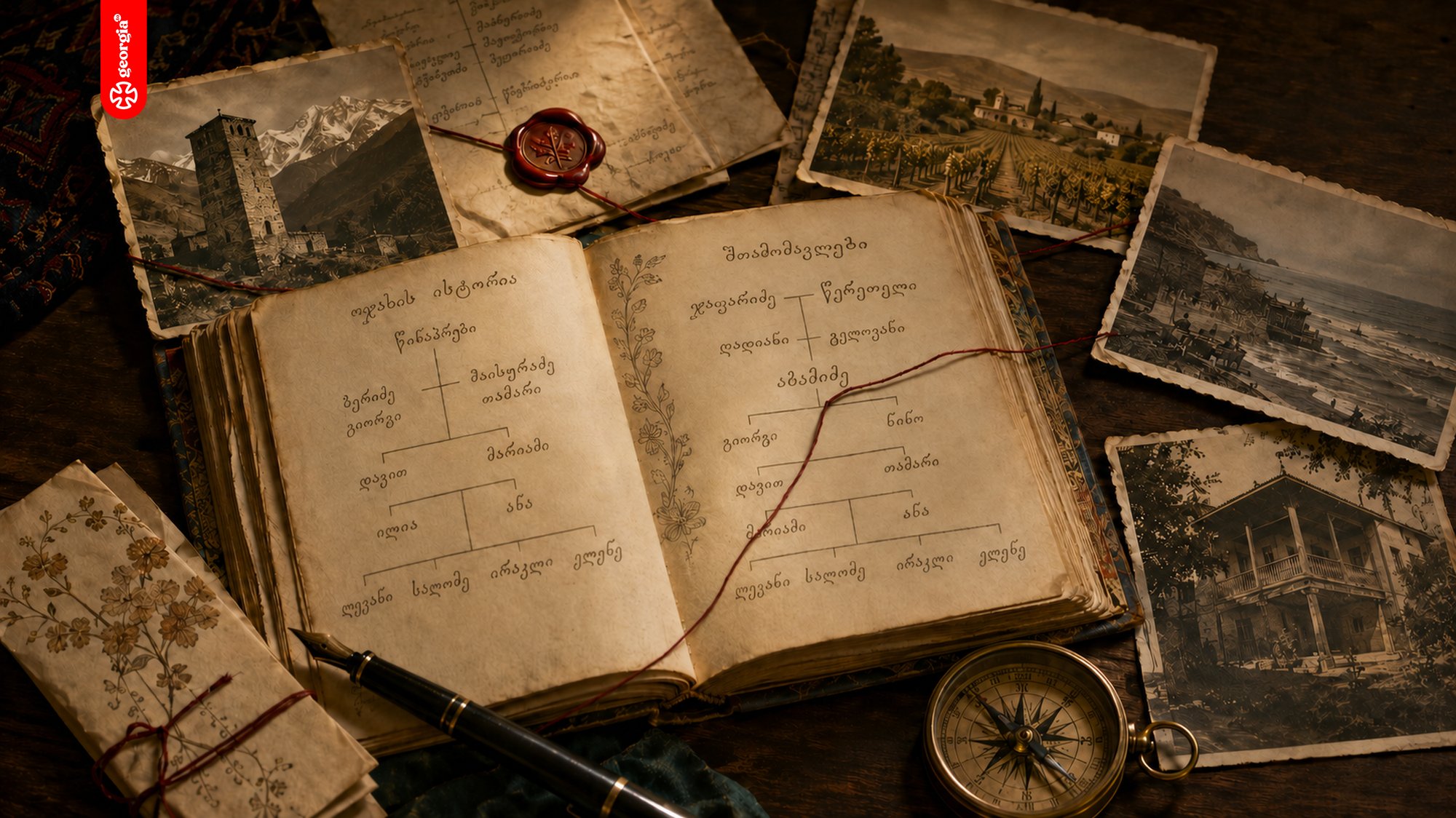
My Own Surname Refuses a Simple Answer
My own surname, Tsimakuridze, ends in -dze.
The first assumption would therefore point toward western Georgia.
That assumption would not be entirely wrong.
But it would be incomplete.
Historical records connect branches of the Tsimakuridze family with Meskheti, Imereti and Kartli. The name appears to have travelled, carried by people who left one region, settled in another and continued their family line somewhere else.
Ett efternamn.
Flera regioner.
Mer än en möjlig väg.
This is why a Georgian surname should never be treated like an exact coordinate.
It is closer to an old map drawn by hand.
The general direction may be accurate.
Some roads may still exist.
Others may have changed.
And part of the journey may be visible only when family stories and historical records are placed beside the name.
SLUTEN PEKAR.
HISTORIEN FÖLJER.
A Map Is Not a Border
It is tempting to turn Georgian surnames into a simple game.
-shvili? Östra Georgien.
-dze? Västra Georgien.
-iani? Svaneti.
-ia? Samegrelo.
Sometimes the game works beautifully.
Sometimes it sends you in entirely the wrong direction.
A surname is evidence of history, not a prison built around identity.
A family with a western ending may have lived in Kakheti for centuries.
Someone born and raised in Tbilisi may carry a surname associated with a mountain village they have visited only twice.
A Georgian living in Paris, Berlin, New York or Athens may carry the name of a place their grandparents were forced to leave.
The same Georgian endings also appear among families whose religious or cultural histories add further layers to the country.
Georgian Jewish surnames, for example, often carry familiar endings such as -shvili and -dze.
Språk, tro, etnicitet och geografi passar inte alltid i separata fack.
Georgiens historia gör det sällan.
Tbilisi proves this every day.
The capital contains names from Kakheti, Imereti, Guria, Samegrelo, Svaneti, Racha, Adjara, Meskheti, the eastern highlands and places beyond Georgia’s present administrative control.
The surnames meet in school registers.
On office doors.
In apartment buildings.
At weddings.
Around the same table.
Staden suddar inte ut deras ursprungliga geografi.
Den samlar kartorna på ett ställe.
In Abkhazia, the Map Also Carries a Wound
Continue northwest along Georgia’s Black Sea coast and the surname map becomes more layered and more painful.
Abkhazia is an integral part of Georgia within its internationally recognised borders. Today, it remains under Russian occupation and outside the effective control of the Georgian government.
Men en ockupation tar inte bort en region ur ett lands historia.
Och den kan inte ta ett hem ur en familjs minne.
Abkhazia has long carried more than one linguistic tradition. Abkhaz family names often appear with endings such as -ba, while Georgian, particularly Megrelian names with endings including -ia, -ua, -ava, -dze and -shvili also belong to the region’s historical human landscape.
Sometimes one family can even appear through different linguistic forms.
The historic ruling house of Abkhazia is known as Sharvashidze in Georgian and Chachba in Abkhaz.
One lineage.
Two languages.
A shared and complicated history.
Recognising Abkhazia as part of Georgia does not require the erasure of Abkhaz names, language or identity.
On the contrary...
they belong within the complete story of a country that has never been culturally uniform.
For families displaced from Sokhumi, Gagra, Ochamchire, Gali and surrounding towns and villages, however, a surname may carry something heavier than regional identity.
It may carry an address they can describe but cannot visit.
A courtyard remembered from childhood.
A family house now seen only in old photographs.
A grave that cannot be reached.
A street whose present name they may not recognise.
The surname travels through Tbilisi, Zugdidi, Kutaisi, Europe or America.
The family carrying it moves forward.
But part of the name continues facing home.
An occupation can close a road.
It can divide families.
It can place fences across familiar land.
It can prevent people from returning to their own houses.
Men den kan inte få minnet inne i ett namn att försvinna.
Kartan består.
When the Name Crosses Another Alphabet
A Georgian surname may travel even when the family never intended it to.
Written in Georgian, the name belongs naturally to one of the world’s most distinctive alphabets.
Then it reaches another country.
Suddenly, it must be converted into Latin, Cyrillic, Greek, Hebrew or another writing system.
Letters change.
Spellings multiply.
A sound represented perfectly by one Georgian character may require two or three Latin letters and a patient explanation at every airport desk.
The same family name may appear differently on old documents, foreign records and modern passports.
Ts kan bli C.
Kh kan förlora sitt h.
Shvili kan skrivas enligt reglerna i ett annat språk.
A name that felt effortless at home becomes something its owner must repeat.
Slowly.
Several times.
“No, there is no space.”
“Yes, all of it is the surname.”
“No, you do not pronounce every letter the way you think.”
And yet the name survives translation.
The alphabet around it changes.
The road behind it does not.
For members of the Georgian diaspora, the surname can become the most visibly Georgian thing they possess.
Their children may speak another language more confidently.
Their grandchildren may know Georgia mainly through summer visits, family stories, food and photographs.
But the name remains beside them in school, at work, on legal documents and on doors far from the place where it began.
A small map carried into another country.
What a Surname Can and Cannot Tell Us
A surname cannot tell us who a person is.
It cannot explain their character.
It cannot determine which language they speak, what they believe or where they consider home.
It cannot replace genealogy, historical documents or the stories preserved inside a family.
And it should never be used to make identity smaller than it really is.
But it can begin a conversation.
Where does your family come from?
Do you still have relatives there?
Is the family house still standing?
Who was the first person to leave?
Why did they go?
Did anyone return?
These questions rarely produce a simple answer.
A Georgian may begin with the name of one village and end with a story involving three regions, a war, a marriage, an unexpected migration and one great-grandmother who apparently made every important decision.
Det är då efternamnet slutar vara en språklig kuriositet.
Det blir en familjehistoria.
The Name Still Knows the Way
Perhaps this is why Georgians ask about surnames so often.
It is not always simple curiosity.
We are trying to understand where the other person stands inside the country’s enormous network of regions, villages, families and remembered connections.
Efternamnet ger oss den första tråden.
Vi följer den varsamt.
Sometimes it leads exactly where expected.
Sometimes it crosses the entire country.
Sometimes it reaches a village emptied long ago.
Sometimes it stops at an occupation line while memory continues beyond it.
And sometimes the person carrying the name has never visited the place it remembers.
Still, the connection survives.
A Georgian name is also a map.
Not a precise map.
Not one with fixed routes and simple borders.
It is a map drawn by language, migration, memory and belonging.
A map that can cross mountains.
Survive exile.
Move between alphabets.
Wait behind a closed road.
And continue pointing home.
You carry it without folding it.
You pass it on without copying it.
And sometimes...
long after the road itself has disappeared...
NAMNET VET FORTFARANDE VÄGEN.